Rast: Service Marketplace Platform
Two-sided marketplace connecting handymen with urban customers seeking home services.
Overview
Designed a two-sided marketplace platform connecting handymen and customers in urban Turkish areas. Working alongside a UX researcher who conducted competitive analysis, I designed desktop interfaces for both sides of the platform—with primary focus on the provider dashboard as a business management tool.
Challenge
Urban handymen struggle to reach new customers at scale.
Newcomers in cities struggle to find trustworthy providers.
Core problem: Two groups who need each other can’t discover each other.
Solution: Platform Flow
Customer path: describe issue → get offers → compare profiles, portfolios, ratings → message → choose → pay → rate.
Provider path: see jobs → bid → if accepted → complete → get paid → rating added to profile.
All payments run in-app — no external cash.
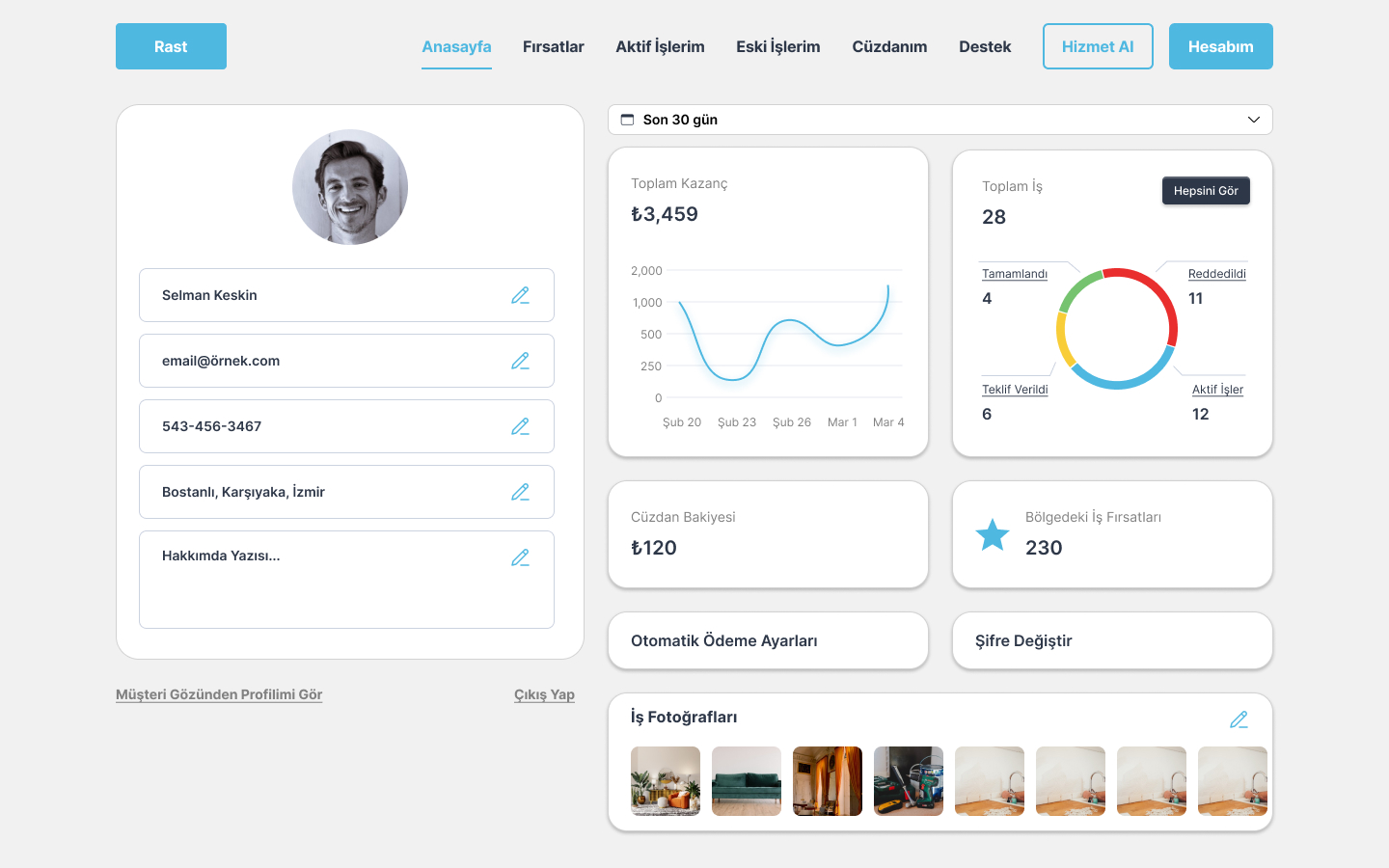
Provider Dashboard Design
New jobs to bid on
Pending offers
Active jobs
Past jobs
Earnings & analytics
Public profile management
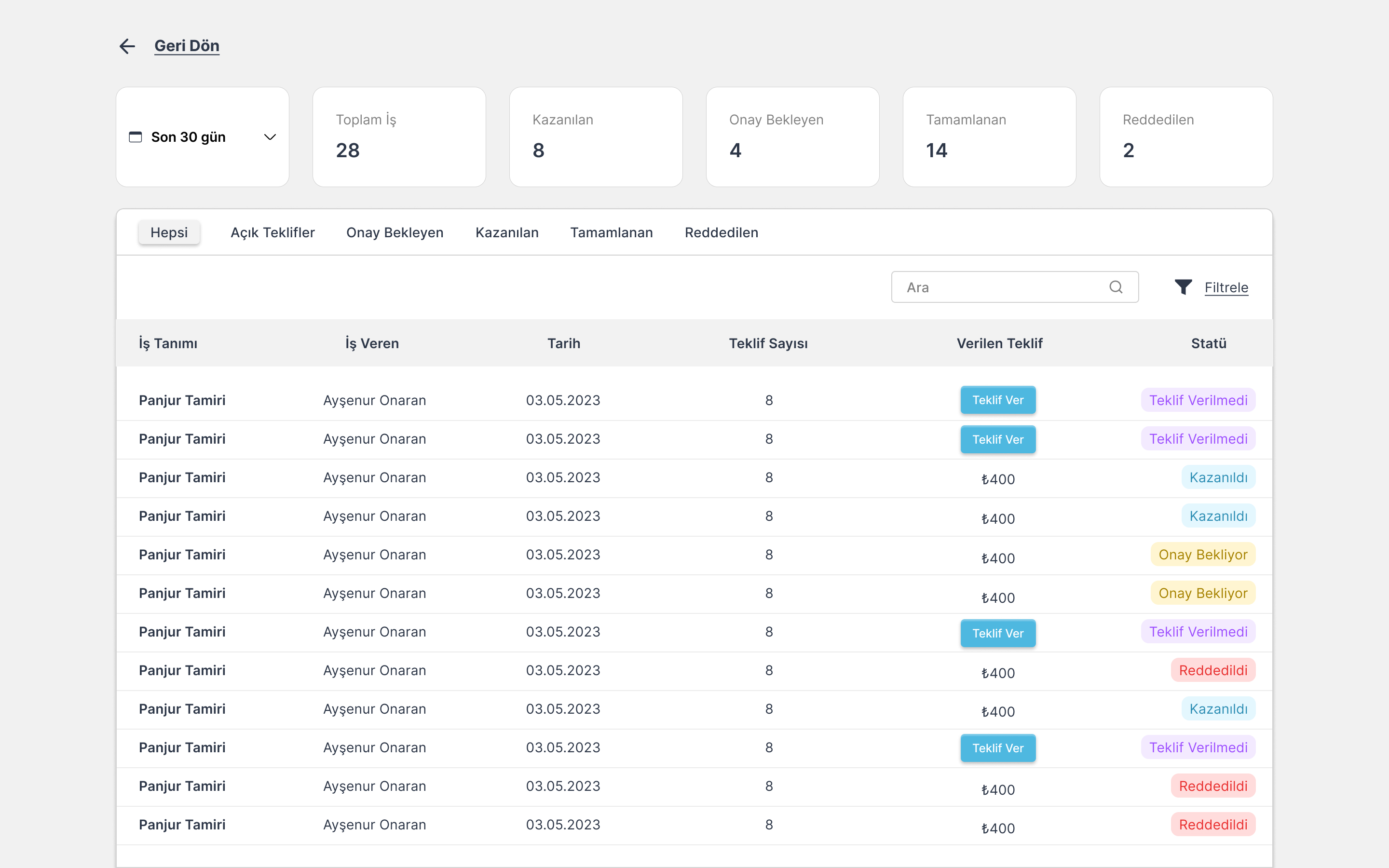
Interactive job states chart: A donut chart shows all job states (opportunity / active / complete / canceled). Clicking a segment filters the job list.
Dual view of jobs: Grid for quick scanning. Table for data-dense comparison. Both share color-coded states.
Earnings analytics: Line charts + see detail on hover.
Profile management Image, description, portfolio, reviews — same view customers see.
Customer Experience
Posting flow: quick initial capture → progressive detail → photos → scheduling → budget.
Bid comparison: offers displayed as cards with trust signals (rating, portfolio, completion rate, response time).
Job tracking: pending / active / completed — all paid in-app.
Core Features
Provider: dashboard, state visualization, grid/table toggle, analytics, portfolio, inline bid & messaging.
Customer: guided posting, comparison UI, trust signals, messaging, ratings, payments.
👋🏻 Personal Notes
The project was ultimately discontinued when investors dropped out. It taught me that good design work doesn't always see launch, and that's part of the reality of working in startups.
Working with a UX researcher taught me how research insights translate into design decisions, particularly around competitive analysis and user flow development.
Looking back, I'd approach the component organization differently (my Figma components were scattered rather than systematically organized), but the core flows and interaction patterns hold up as solid foundational work.
Role: UX/UI Designer
Timeline: January - March 2023 (Project discontinued due to funding)
The prototypes are in Turkish since the app was planned to launch in Turkey.

Figma